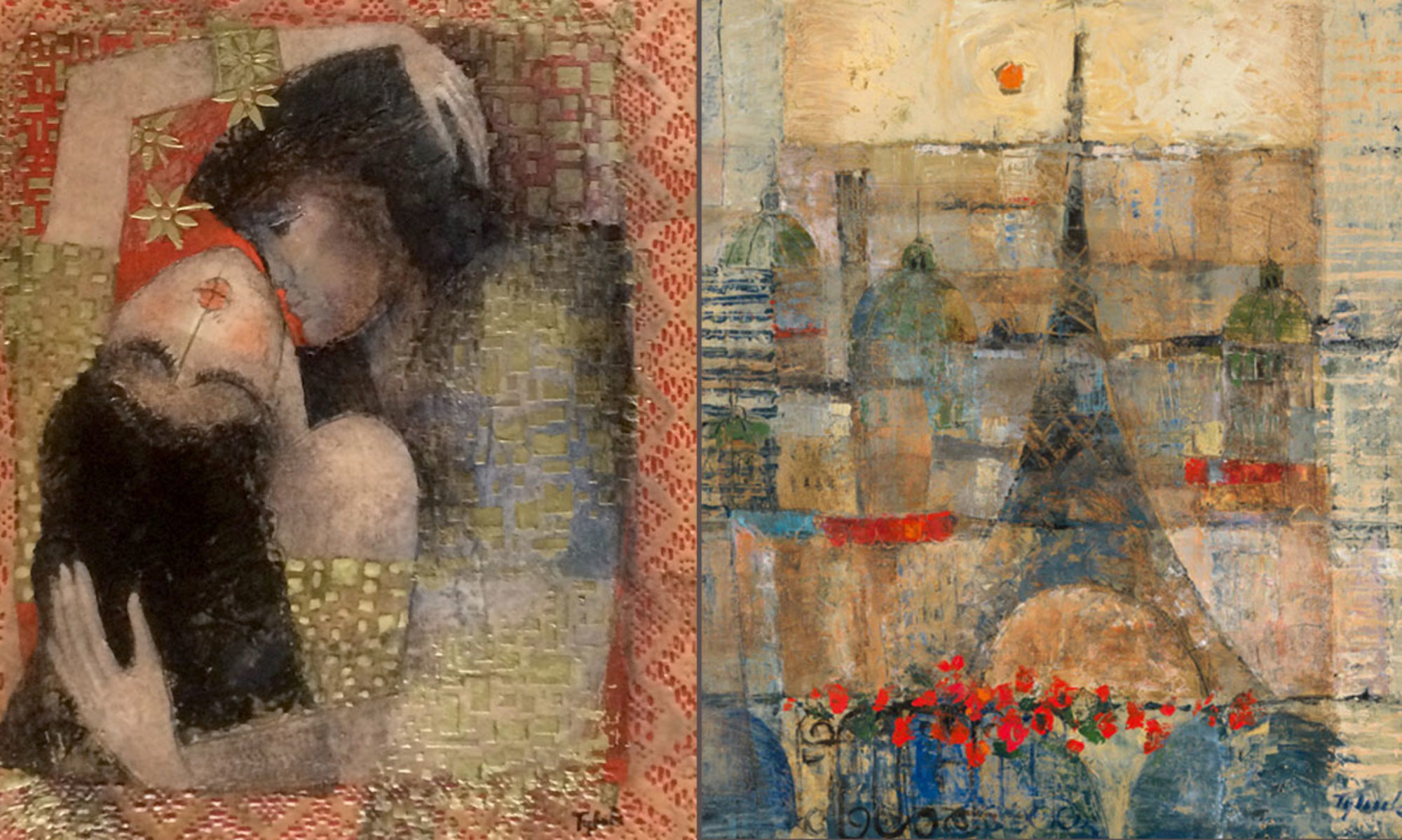

Zdeňka Šírová was born in Brno and Jiří Tyleček in Ostrava, both in 1948 in Czechoslovakia.
They met at a very young age at the School of Applied Arts in Brno, where they completed their studies in monumental painting in 1967. Two years after graduating, they married, moved to Ostrava to work and start a family.
In 1970, Jiří joined a television studio in Ostrava as a set designer, where he remained for thirteen years. He knew that painting was his life, but he also knew that, as a young graduate, he would not be able to make a living solely from his painting. Zdenka took care of the family and their two children, and both painted intensively.
Their first exhibition took place in Opava, arousing great interest; many others followed in the region. However, their paintings did not seem sufficiently committed in the eyes of the commission which, at the time, decided which works of art would be accepted into state galleries. And works could only be sold through these galleries. The commission had its own tastes and its own instructions. The Tylečeks’ paintings were not ‘communist enough’.
Jiri and Zdenka both realised that they had to change their lives, that they lacked contact with the outside world and, above all, the opportunity to breathe, think and create freely.
They seized the opportunity to emigrate to France with their two young children during a trip to Spain in 1983. They dreamed of Paris, had no money, did not know the language, but they finally found themselves in the Mecca of artists, and Paris did not disappoint them. They started their new life with empty pockets. Jiri took a job as a house painter, Zdenka did cleaning work. They learned French as they went along and, whenever they had a moment, they painted in the kitchen of the tiny flat they rented in Paris.
Jiri: “I had a notebook and a pencil. I started drawing. There was an art supply store, and I traded a drawing for a tube of paint. I bartered and found my first three cardboard boxes on the street, which I painted with these paints… and that’s how the first three paintings were made. They were gradually sold to our first acquaintances for a little money, which we were able to reinvest…”
Despite a difficult start, the two artists’ careers took off after five years. After a few small exhibitions in Paris, their first gallery, ‘Art-Atelier’, opened its doors at 92 Rue Daguerre near Montparnasse and remained open for twenty-seven years. A happy coincidence helped them achieve this: they won twenty thousand francs in the lottery, a sum that no one would have lent to Czech immigrants for such a risky venture.
It was a very bold but important step, because in this gallery, which was also their studio at the beginning, they began to build up a very loyal clientele of ‘admirers’ and also a few enthusiasts who would help them exhibit elsewhere: Angoulême, Thionville, Corsica, Martinique, Guadeloupe…
After a few years and numerous exhibitions, they first rented a display window, then a gallery in the famous Parisian hotel Le Ritz, Place Vendôme, and the adventure lasted fifteen years. There they met many clients, mainly foreigners, who were of great importance to their future career. For example, a Japanese entrepreneur opened the doors to Japan, a country where they have frequently exhibited since then.
Jiri: ‘It may seem strange in Europe, but they opened a museum for us. I prefer to call it a permanent exhibition, but it is a large house where we exhibit eighty paintings.’
It was also there that they met the virtuoso Vaclav Hudecek and his wife Eva, who are still close friends. Vaclav Hudecek has opened many of their exhibitions since then.
It was here again, in October 2003, that they organised a Moulin Rouge-themed evening. This spectacular opening at the Ritz Club combined works by Tylek & Tyleček, Japanese floral art ‘Ikebana’ and live music… A festival of red, crimson, garnet and vermilion, a dazzling palette that warmed the hearts of Parisians in the middle of autumn… Tylek, playing on the romantic colours of red and black, transformed his lascivious heroines of Parisian nights into timeless aesthetic figures reminiscent of Cretan, Byzantine or Japanese art. Moreover, the extreme stylisation of their bodies, the decorative motifs that make up their hair, and the setting that surrounds them show that Tylek never succumbed for a single moment to the seductive powers of ‘realistic’ erotic art. Tylek transformed his dancers dressed in black stockings into captivating icons.
At the same time, the artists have made a name for themselves around the world: their works are displayed in numerous cities in France, Martinique, Corsica, Switzerland, Italy, Australia, the United States, Belgium, Tahiti, Japan, and the Czech Republic, as well as at the Mihama Museum in Japan.
The biggest event of 2005 was, of course, their participation in the Japanese World Expo in Aichi. Japan honoured the European painters Tylek & Tyleček. As part of this, they exhibited one hundred paintings created on the theme of the five continents – in homage to the Japanese explorer Otokic.
The two artists worked on this project for over four years, preparing these large-format paintings in their studio in Flot Mesnil: 2.5 tonnes of canvases, frames and boxes to be shipped… Each continent is exhibited in a separate space with appropriate scenography and music. The result is fascinating. To mark the occasion, the painters are publishing their sixth book, which presents the entire exhibition.
Tylek: ‘We really appreciated the fact that the entire collection remained intact and was not scattered. An entrepreneur bought the whole lot.’
From 2014 to 2016, Tylek & Tyleček exhibited continuously at the Apsara gallery-boutique at 96 Avenue Mozart in the 16th arrondissement of Paris.
In order to preserve the traditional Czech principle, Zdenka Tyleček (in Czech Zdeňka Tylečková) adopted the longer name Tyleček, while Jiri is known by the pseudonym Tylek.
Motivated by her ability to feel the beauty of nature with extraordinary intensity, Tyleček devoted herself to landscapes and still lifes. Her paintings, full of optimism and energy, have a strong relief that gives the paintings a structural character.
Tylek painted characters, mainly female. His paintings depict delicate, pure and tender women, who could be queens, musicians, nymphs, mermaids, virgins – often with their heads slightly tilted. His paintings have a distinctive style and technique. He tried to represent women differently and used to say that he had to put his gaze, his imagination and his emotion into the painting… and attract interest with that.
“I seek grace, not beauty. That is the way of the future. To create something that does not exist in reality, but which the viewer considers to be reality. I fell in love with painting at the age of six and haven’t left it since. I would do anything for art. People say we’re crazy, but it’s not madness. We really want to do our best for art. The current era needs to rediscover its beauty and poetry. I shake my head at what I see in galleries and tell myself that not everything is so ugly, that there are beautiful things in the world,” explains Tylek.
Few contemporary Czech artists have enjoyed such success abroad. They did not present themselves as soloists: the husband and wife team formed the couple Tylek & Tyleček, inseparable in life and art. It is now a renowned art brand.
Jiri Tyleček died unexpectedly in February 2019 at the age of 71.
Zdenka continues to paint and still organises exhibitions in France, the Czech Republic and elsewhere in Europe…